

The Cuyo region in Argentina is revolutionizing the mining sector that extends beyond traditional extraction methods. With the upcoming annual Argentina Mining Cuyo 2025 conference, the country should expect technological innovation, government policy, and international investment to intersect to reshape the mining landscape. The region offers proximity to Pacific export routes while maintaining lower operational costs. Argentina is a leader in copper, gold, and lithium mining in South America. The mining infrastructure includes operations, export logistics, and expansion. Additionally, the integration of advanced technologies shows a shift in how companies approach exploration, extraction, and operational monitoring. Downlead clamps function in the mining infrastructure to fasten the down conductor carrying the lightning strike current from the peak of a structure to the ground and to the structure itself.
Mining operations in Argentina are often in harsh and remote environments of mining sites. These environments demand robust and durable components like the downlead clamps. The clamp’s design holds the cable firmly against the structure to prevent the movement that could damage the cable. The clamps consist of corrosion-resistant materials like hot-dip galvanized steel to withstand UV radiation, temperature fluctuations, and strong winds. The clamp provides excellent electrical connection between the down conductor and the structure. Additionally, it ensures the lightning current stays within the dedicated protection system rather than arcing to other paths.
Download clamps are designed for various applications, including flat surface clamps, pipe-hugging clamps, and reinforcement bar clamps. They connect the down conductor to the rebar in concrete foundations. The use of the downlead clamps is essential for securing, conducting, and protecting assets. Its reliable performance is crucial for the risk management strategy that allows Argentina’s mining sector to operate safely.
Implementation of AI in Argentina’s mining sector
The implementation of AI in Argentina’s mining sector has the potential to transform the industry and improve efficiency, safety, and sustainability. The country has the opportunity to leverage AI technologies in areas ranging from exploration and resource extraction to environmental monitoring. AI plays a crucial role in mineral exploration, automation of mining operations, enhancing safety with AI, monitoring, supply chain, and logistics. Integration of AI into Argentina’s mining industry helps overcome challenges of investment, data quality, and workforce development. The mining sector can harness AI to lead traditional and emerging markets in high-demand minerals like lithium and copper. Using downlead clamps helps enhance and secure the connections for mining in Argentina.
The functions of downlead clamps in Argentina’s mining sector
Using downlead clamps ensures safe, efficient, and reliable operation of electrical and communication systems used across mining sites. The clamps also support renewable-powered mining operations that rely on solar or wind energy. Additionally, this helps reduce carbon emissions and energy costs. Here are the functions of the downlead clamps in Argentina’s mining infrastructure.
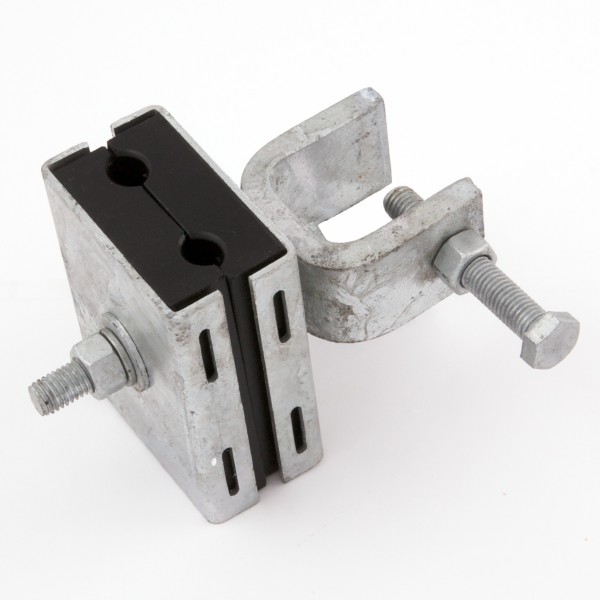
- Securing downleads to transmission structures—downlead clamps secure optical ground wires or fiber optic cables to transmission towers. The clamps hold the cables firmly along the tower structure to ensure the downleads remain in place.
- Protecting cables from mechanical stress—the clamps help absorb mechanical stress and prevent cable damage caused by movement or tension. This helps extend the lifespan of the cable transmitting power and data between substations and mining control centers.
- Easing safe electrical grounding—downlead clamps help connect the grounding conductors from the OPGW to the tower’s grounding network. This ensures effective grounding protection and surge dissipation. They reduce electrical hazards and equipment failures.
- Supporting fiber optic communication networks—mining operations use real-time data transmission systems for process automation, safety monitoring, and equipment tracking. The clamps ensure a stable and interference-free route of fiber optic cables from the top of the tower to the base.
Technological innovations in Argentine mining
Using technological advancements in the mining sector helps increase competitiveness, sustainability, and access to finance. The advancements help raise productivity and lower costs in remote areas and help Argentina leverage its rich critical-mineral endowment. These innovations include
- Sustainable extraction and critical mineral focus—these technologies include direct lithium extraction technologies that reduce water usage. Mines are also integrating renewable energy sources, aiming to reduce carbon footprints.
- Advanced exploration tech and remote sensing—these include drones with RGB, thermal, and LiDAR sensors to identify mineral anomalies.
- Automation, robotics, and sensor networks—autonomous drilling rigs, haul trucks, and robots performing inspections—reduce human exposure to risks.
- Traceability, software, and digital systems—these are tools that monitor ore movement, track environmental data, and satisfy customers’ demands.